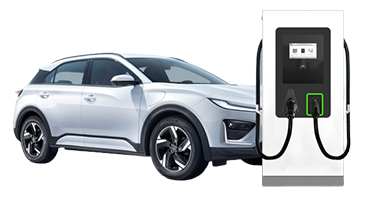
A successful OEM EV charger project begins with a precise product brief covering the target market, charger category, charging power configuration, connector, interface language, communication method, appearance, and packaging. OEM is most effective when a brand adapts an established charging platform, while deeper ODM work may involve broader product changes. Separating mandatory specifications from optional features helps create a clear and verifiable product requirement document.
U-charging supports OEM and ODM directions across AC EV chargers, DC fast chargers and charging management requirements. The practical goal is not to add every available feature, but to build a coherent configuration for the vehicles, users, electrical environment, and operating model in the intended market.
Who Is OEM EV Charger Service For?
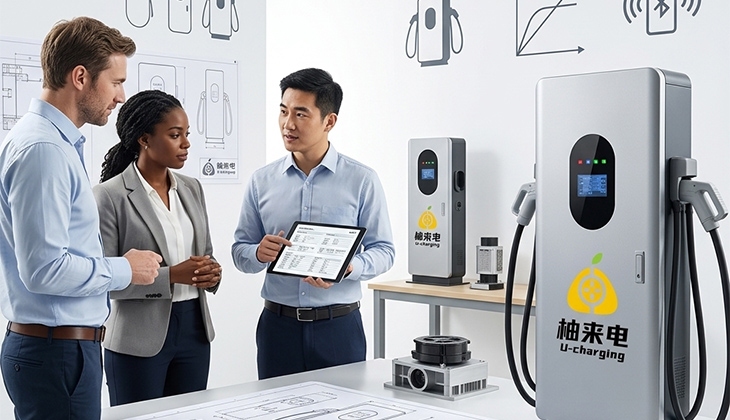
OEM EV charger service is primarily designed for B2B customers that need charging equipment aligned with their own brand, sales channel, project requirements, or operating model. The required level of customization can vary significantly between a distributor launching a private-label product line and a charging operator integrating equipment into an existing network.
EV Charger Distributors and Electrical Equipment Brands
Distributors and electrical equipment brands may use an established charger platform while developing their own market-facing identity. Depending on the confirmed OEM scope, this may involve logo application, housing appearance, interface language, product labeling, packaging, or market-specific product configurations.
Energy Companies and Charge Point Operators
Energy companies and CPOs typically place greater emphasis on charger power, communication, backend integration, user authentication, payment workflow, and operation management. These requirements should be matched to a specific charger model rather than assumed to be available across the complete product range.
EPC Contractors and Project Integrators
EPC contractors need equipment that fits project drawings, electrical capacity, installation conditions, connector requirements, documentation, and commissioning plans. For these buyers, OEM EV charger selection is closely connected with technical specification management and project delivery.
Fleet Solution Providers
Fleet charging projects may prioritize vehicle compatibility, charging windows, site capacity, connector configuration, remote monitoring, and operational consistency. Selecting the appropriate OEM AC EV charger or OEM DC fast charger therefore begins with the fleet’s actual operating requirements.
Why Build Your Own EV Charger Brand?
Building an own-brand charger line can give distributors greater control over product positioning, channel strategy, customer-facing branding, and portfolio development.
What Can Be Customized in an OEM EV Charger Solution?
OEM Product Customization
OEM EV charger projects typically start from an existing charging platform. Branding, appearance, interface, connector, communication, and packaging requirements can then be evaluated according to the selected model and project scope.
ODM Product Development
ODM development may include customized hardware design, firmware development, mechanical engineering, industrial design, and system integration based on specific market requirements.
| Feature | Standard | Opcional | Custom / Project-Based |
| Rated charging power | Defined by selected charger model | Alternative standard model/configuration | Non-standard requirement subject to feasibility review |
| Aplicativo / RFID | Available on selected published models | Model-dependent | Operating workflow subject to project confirmation |
| OCPP | OCPP 1.6J on selected published models | OCPP 2.0 on selected models | Backend/platform integration subject to confirmation |
| 4G / Wi-Fi / Ethernet / Bluetooth | Defined by selected model | Model-dependent | Project communication requirements require confirmation |
| POS / payment interface | Not universal | Optional on selected commercial models | Payment workflow depends on platform and project |
| Connector | Defined by selected market/model configuration | Alternative where supported | Requires model-level technical confirmation |
| Logo / branding | Standard product branding | — | OEM branding subject to confirmed scope |
| Housing / appearance | Standard enclosure | — | OEM/ODM adjustment subject to feasibility |
| UI / language | Standard product interface | Model-dependent | OEM/ODM adjustment subject to confirmation |
| Packaging / labeling | Standard product packaging | — | Private-label packaging/labeling subject to project scope |
| Hardware / firmware redesign | Existing platform | — | ODM work subject to technical feasibility |
Custom does not mean unlimited modification. Any change affecting electrical architecture, firmware, enclosure design, connector layout, certification, safety, tooling, or manufacturing must pass technical and commercial feasibility review before approval.
Define the Target Product Category
Choose an OEM AC EV Charger Platform
U-charging’s current AC charging solutions includes several established platforms rather than one universal power series. Examples include the 7–22kW Smart AC EV Charger in 7kW, 11kW, and 22kW configurations; 14–42kW AC charger platforms offered in 14kW and 42kW versions; the 22–42kW Dual-Gun AC Charger; and a dedicated 43kW AC EV Charger.
For an OEM AC EV charger project, buyers should select the base platform first, then confirm installation format, connector arrangement, communication, user access, branding, and destination-market requirements against the selected product datasheet.
Choose an OEM DC Fast Charger Platform
U-charging’s current public DC portfolio includes compact 20–40kW and 30–40kW platforms, a 40–60kW DC EV Charger, 120–180kW DC fast charging platforms, a 120–240kW Low-noise DC Fast Charger, and a 240–480kW DC Fast Charger. These product ranges cover different commercial, fleet, public charging, and high-throughput applications.
A published power range should not be interpreted as confirmation that every intermediate rating is a standard configuration. For an OEM DC fast charger project, the exact rated power, number of connectors, output specifications, communication functions, and operating features should be verified against the selected model and current datasheet.
Match Connector Requirements to the Selected Charger
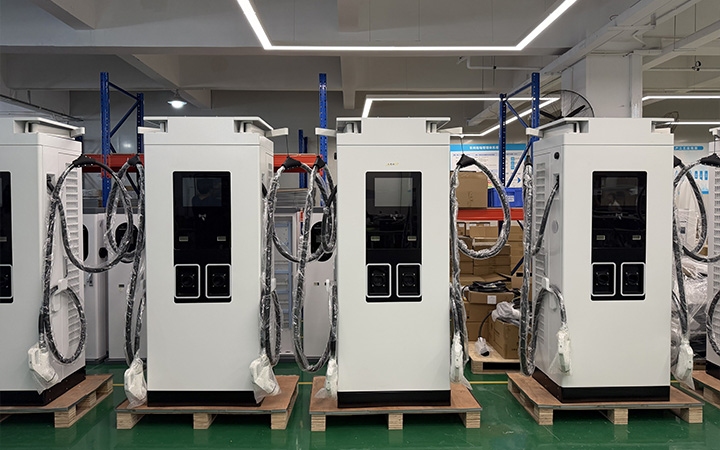
Connector availability should be confirmed at model level rather than treated as a portfolio-wide specification. For example, the DC 60kW + AC 22kW Integrated Charger is published with CCS2/CCS1 DC interfaces and a Type 2 AC interface, while the DC 60kW + AC 43kW Integrated Charger uses a CHAdeMO/CCS2/Type 2 configuration.
The OEM specification should identify the destination market, target vehicles, connector standard, voltage and current requirements, and cable configuration.
Confirm Connectivity and Software at Model Level
Connectivity and operating functions should be specified against the selected charger rather than described as universal U-charging features. For example, the 7kW / 11kW / 22kW Smart AC EV Charger lists APP/RFID access, 4G, Wi-Fi, Ethernet, Bluetooth, and OCPP 1.6J, with OCPP 2.0 shown as optional. Selected DC products such as the 120–240kW Low-noise DC Fast Charger also list APP/RFID, multiple communication methods, OCPP 1.6J, and optional POS and OCPP 2.0.
The OEM brief should identify which communication method, OCPP version, authentication method, payment interface, and backend workflow are mandatory before the final configuration is approved.
How Does an OEM EV Charger Project Work?
Market Analysis → Product Selection → Technical Specification → Branding → Prototype → Testing → Mass Production → Packaging → Delivery & Support
Prepare Packaging and Documentation
Packaging is part of the customer experience and the product configuration record. It should identify the correct charger variant, connector, accessories, handling requirements, and documentation.
Plan Private Label Packaging
Private label packaging may carry customer branding and market-specific product information. Public materials do not state packaging materials, dimensions, quantities, or testing standards, so the final packaging specification should be based on the selected product rather than a generic template.
Align Manuals With the Product
Manuals and labels should match the actual power configuration, connector, installation method, interface language, and included functions. Certification marks, compliance statements, and technical data must only be added when the supporting documentation applies to the exact product variant.
Why Choose U-charging for OEM EV Chargers?
U-charging supports OEM EV charger projects based on established AC and DC charging platforms, allowing B2B customers to select a suitable base model and define market-specific requirements for power, connectors, communication, branding, interface, and packaging. Its structured OEM/ODM process supports projects from specification and prototype validation through production, delivery, and long-term cooperation.

Conclusão
A successful OEM EV charger project combines the right AC or DC platform with clearly defined standard, optional, and custom requirements. Confirming power, connectors, communication, branding, documentation, and packaging at product level helps create a more consistent specification for the target market.
Planning to launch or expand your own EV charger brand? Request an OEM consultation, get the latest OEM product catalog, or talk to a U-charging engineer about the AC or DC platform that fits your target market.
Perguntas frequentes
Q: What is the difference between OEM and ODM EV chargers?
A: OEM usually adapts an established charger platform through agreed elements such as branding, appearance, language, connector direction, or packaging. ODM may involve broader product development. The exact boundary depends on the engineering scope, so tooling, ownership, functions, documentation, and approval responsibilities should be defined before development begins.
Q: Which EV charger features can be customized?
A: U-charging materials identify customer branding, product appearance, interface language, connector direction, and packaging as customization areas. Communication and management requirements can also be discussed by product. Not every option applies to every charger, so the final feature list must be confirmed against the selected AC, DC, or portable configuration.
Q: What is the MOQ for OEM EV chargers?
A: MOQ depends on the selected charger model, customization scope, branding, and packaging requirements. U-charging indicates that small trial orders are available for many models, while the final MOQ should be confirmed for the specific AC or DC charger before quotation and production planning.
Q: Can I use my own brand and packaging for OEM EV chargers?
A: Own-brand requirements can be discussed as part of an OEM EV charger project, including items such as logo application, appearance, UI, labeling, and packaging. The exact private label EV charger scope should be confirmed during the requirements and feasibility stages because branding changes, packaging specifications, documentation, and certification-related information may vary by model and destination market.