
The commercial charging of electric vehicles will have clear value if the charger choice, the electrical capacity of the site, rules and regulations, pricing model, and operating model correspond to reality. Hotels, offices, shopping centers, and mixed-use sites can use AC charging stations for extended periods of parking time and selective DC fast charging for higher turnover. The Return On Investment needs to be considered based on individual project parameters, not on an industry promise.
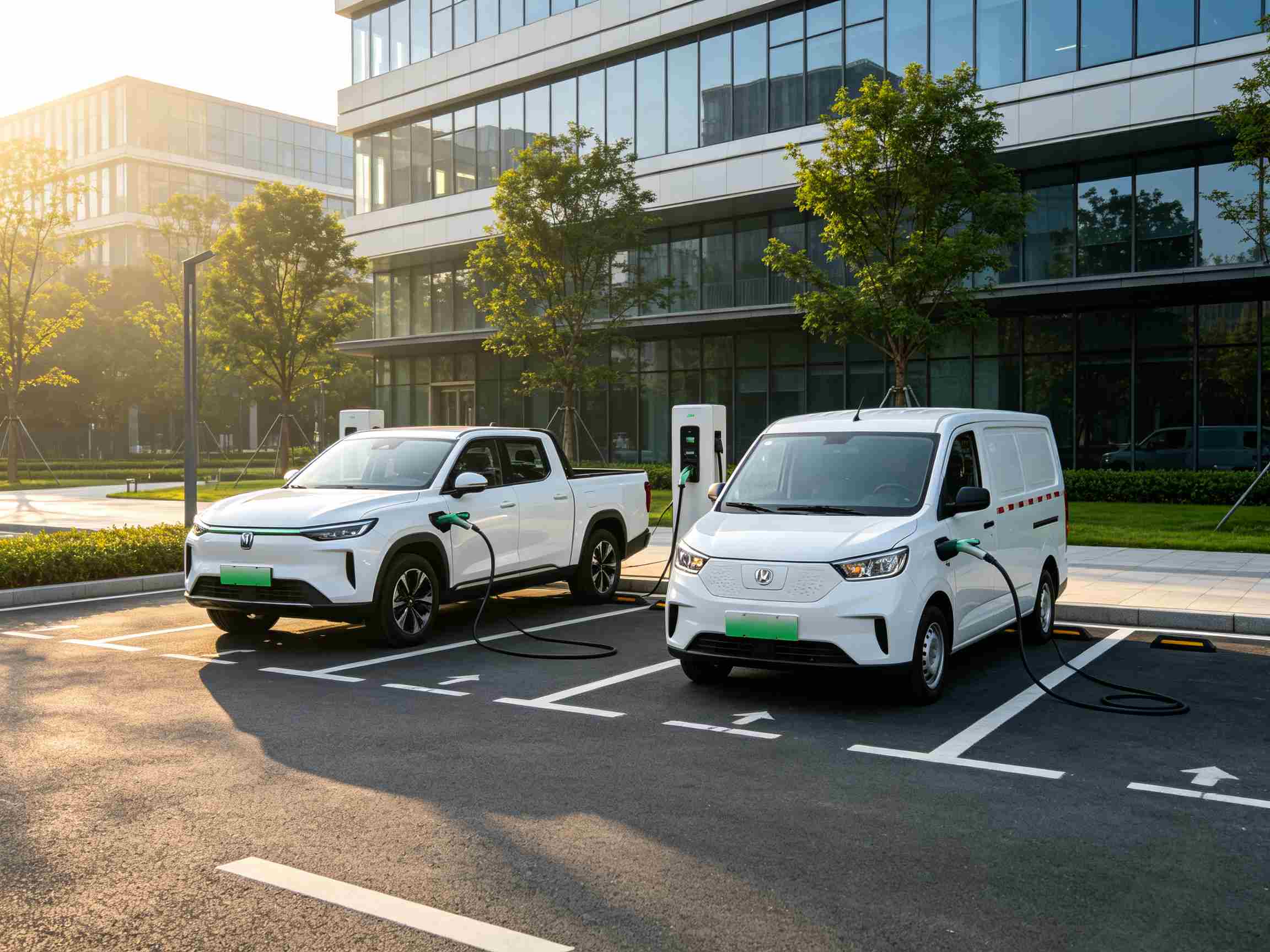
Why Commercial Properties Are Adding EV Charging
Support Tenant and Visitor Experience
Charging increases the functional value of parking spaces for existing user groups such as guests, employees, tenants and visitors. A hotel may offer recharging in between overnight stays of its guests, an office space recharging of parking spaces of employees, a retail property recharging of parking spaces of shoppers during extended shopping trips.
Turn Parking Capacity Into a Managed EV Charging Service
A charging area can be offered as a paid service, as an amenity included in the overall property price or as a managed service offered by the property owner or by a Charge Point Operator (CPO) as part of a package. Key considerations include who can start a session, how long a car can park to charge up, who will provide support and how will consumption of electricity and any maintenance be recorded.
Choose the Right EV Charging Solutions for Commercial Properties
AC EV Charging for Hotels, Offices, and Long-Dwell Parking
Our AC EV charging products are offered in 7kW, 11kW and 22kW variants. When an EV uses an AC EV charging station, the EVSE supplies AC power and the vehicle’s onboard charger (OBC) then converts the AC power to DC power for the EV’s battery. The actual rate of charging using AC power is limited by the lower of the charger’s rated output, the rated OBC of the vehicle, the cable rating and current rating and the available power at the site. Some models can be scheduled, have RFID or app access control, have multiple connection options and can have integration with back end systems using OCPP. These functions must be verified against the specific model and project requirements.
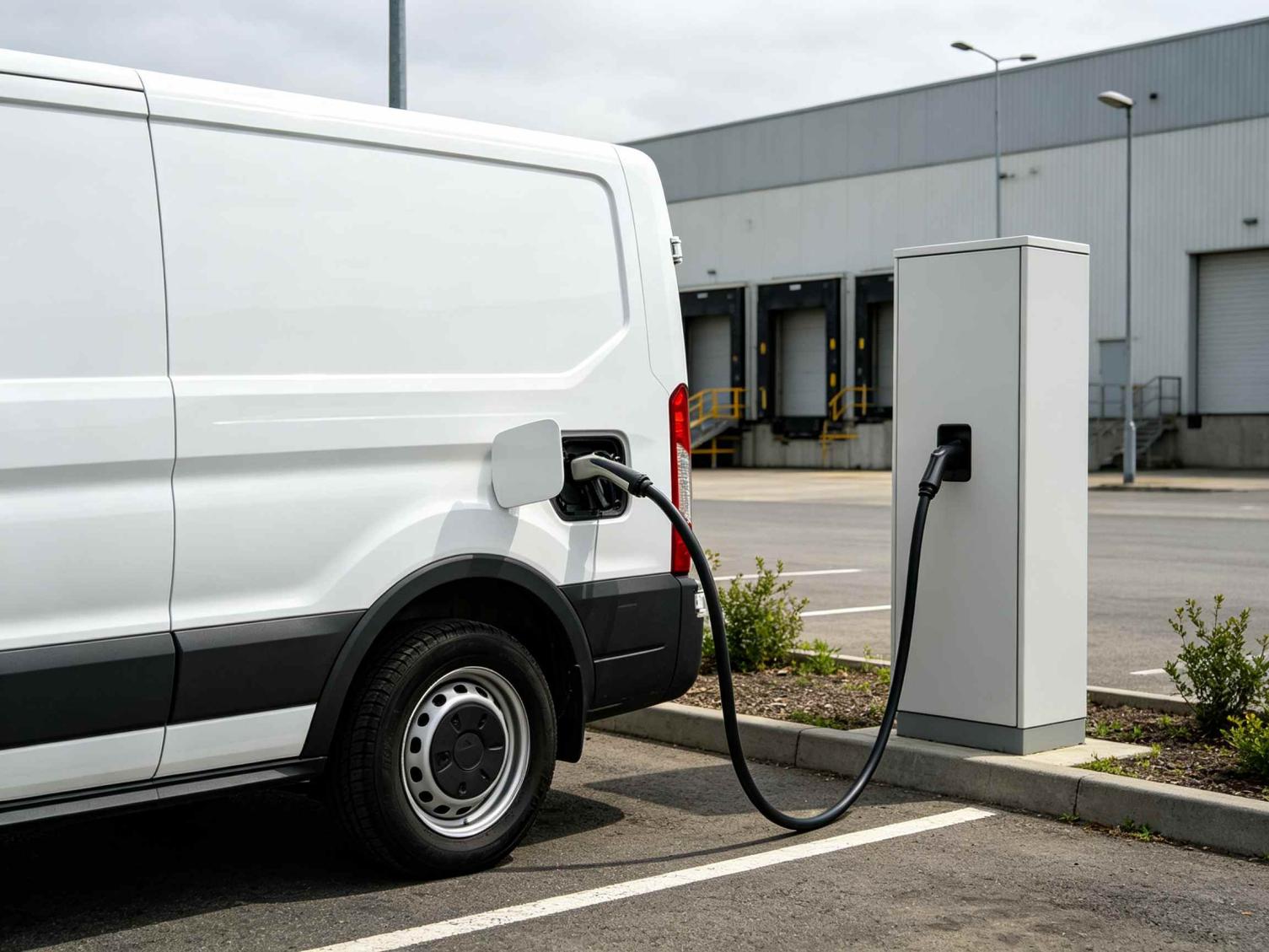
DC Fast Charging for High-Turnover Commercial Sites
U-charging offers DC charging platforms, consisting of compact 20-40 kW units up to powerful 240-480 kW fast chargers. Besides these core charging power classes, U-charging also offers a range of intermediate models for commercial and public charging. The various types of DC charging stations are particularly suitable for public parking spaces, service areas, retail locations and commercial sites. DC fast charging bypasses the vehicle’s onboard charger (OBC) and supplies the vehicle with direct current (DC). The actual DC charging power is determined by the vehicle’s DC fast charging acceptance and charging curve as well as by the battery’s state of charge, temperature, connector and current limits, charger sharing and site power. This is why the charger’s nameplate power must not be presented as the guaranteed vehicle charging rate.
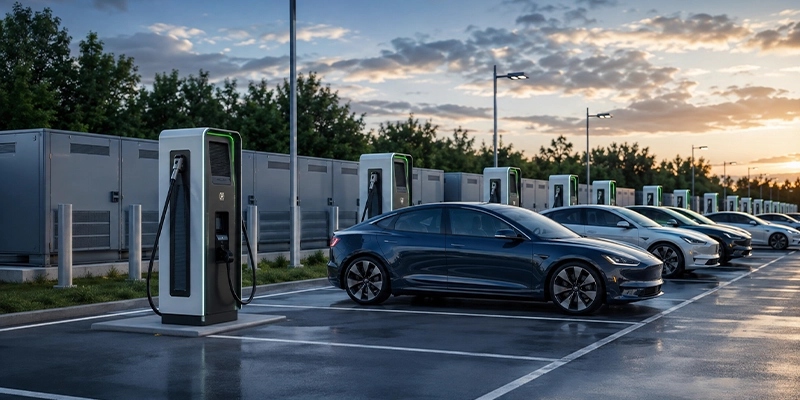
Mixed AC and DC Deployment
A mixed AC/DC deployment can allocate AC charging bays to long-dwell users while reserving selected DC capacity for higher-turnover demand. This requires clear bay rules, electrical planning, connector selection, and support for both charger types.
|
Property setting |
Typical dwell |
Revenue or value model |
Planning emphasis |
|---|---|---|---|
|
Hotel |
Durante la noche |
Amenity or parking package |
Guest access and support |
|
Oficina |
Workday |
Tenant or employee benefit |
Schedules and shared bays |
|
Retail |
Short to medium |
Direct fee or visitor service |
Visibility and turnover |
|
Mixed-use |
Variable |
Combined access policy |
AC/DC zones and expansion |
Revenue Models for Commercial EV Charging
Direct Charging Fees
A property may charge by energy, time, session, or a configured combination when the platform and local rules support that model. Results depend on sessions, electricity cost, payment processing, maintenance, parking policy, and service expenses. Fees should remain understandable to drivers and manageable for staff.
Parking and Amenity Bundles
Hotels, offices, and mixed-use properties may include charging within a parking package, tenant benefit, visitor amenity, or loyalty program. The operator should establish a method for allocating electricity costs and defining charging-related operating expenses.
Tenant, Employee, and Visitor Charging Access
RFID, app, or card activation can separate employees, tenants, guests, fleet users, and public drivers depending on configuration. The operating team should document who can change prices, authorize sessions, and resolve disputes.
|
ROI input |
Examples to measure |
Why it matters |
Avoid assuming |
|---|---|---|---|
|
Capital |
Hardware, civil, electrical work |
Sets initial investment |
One universal cost |
|
Operations |
Energy, network, payment, maintenance |
Shapes recurring cost |
Revenue without accounting for operating and maintenance costs |
|
Demand |
Sessions, duration, user groups |
Indicates utilization |
Average demand without time-of-day or user-segment analysis |
|
Value |
Fees, parking, amenity, tenant use |
Defines benefit |
One fixed payback outcome |
A Practical ROI Calculation Model
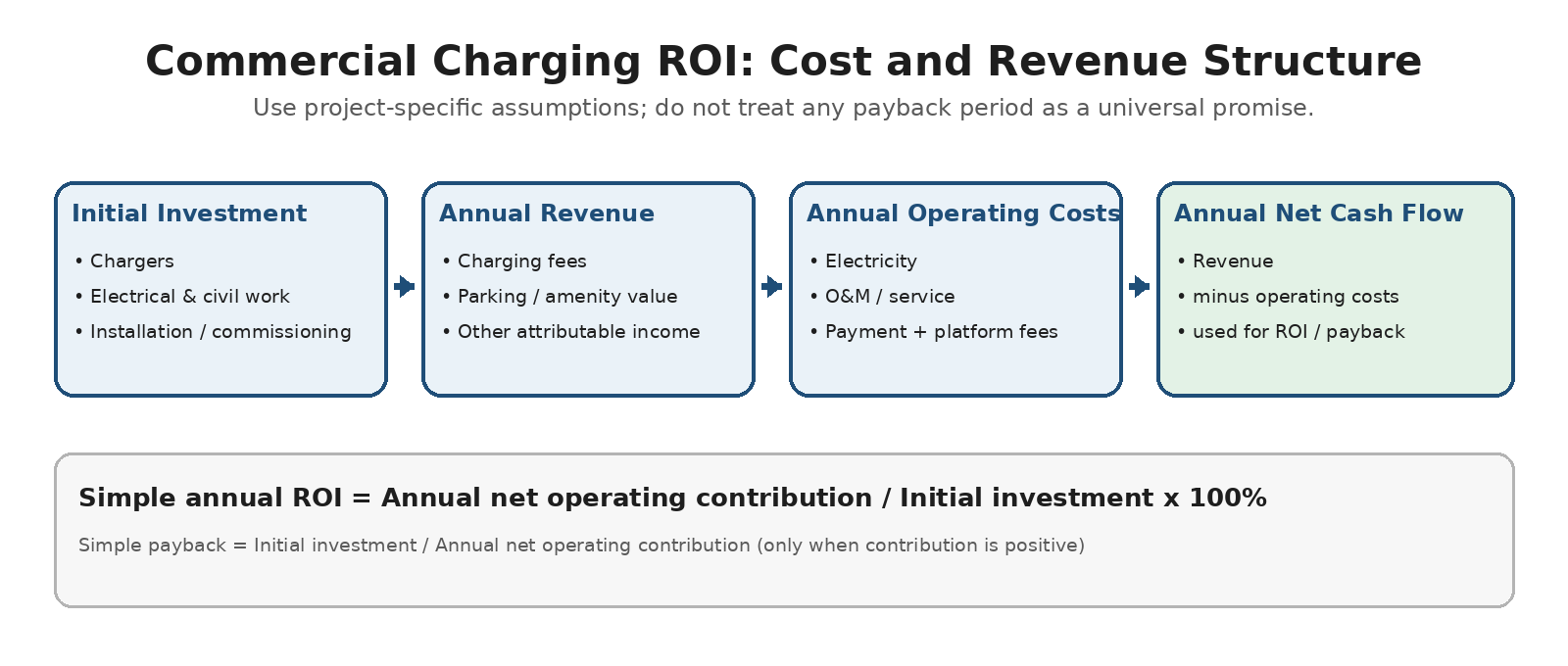
Start with annual cash flow rather than a promised payback period. A simple project model can use the following logic:
Annual net operating contribution = Charging revenue + attributable parking/amenity value – electricity cost – O&M – payment fees – platform/network fees – other recurring site costs
Simple annual ROI = annual net operating contribution / initial investment x 100%. Simple payback = initial investment / annual net operating contribution, but only when annual contribution is positive. For longer-term investment decisions, owners may also add financing, taxes, depreciation, incentives, demand charges, revenue sharing, and NPV/IRR analysis.
Illustrative Example: Commercial Charging Site
ILLUSTRATIVE EXAMPLE ONLY – The following figures are hypothetical and are not a real project result, quotation, forecast, or guarantee of return.
|
Input / output |
Illustrative value |
Calculation / note |
|---|---|---|
|
Initial project investment |
$85,000 |
Hardware, electrical/civil work, installation and commissioning |
|
Annual delivered energy |
110,000 kWh |
Assumed measured energy sold to drivers |
|
Average charging price |
$0.38/kWh |
Illustrative blended customer price |
|
Annual charging revenue |
$41,800 |
110,000 kWh x $0.38/kWh |
|
Electricity cost |
$18,700 |
110,000 kWh x $0.17/kWh |
|
Payment processing |
$1,254 |
Illustrative 3% of charging revenue |
|
Platform / network fees |
$2,400 |
Illustrative annual software/connectivity cost |
|
Routine O&M / service |
$4,000 |
Illustrative preventive and corrective service allowance |
|
Other recurring site costs |
$1,500 |
Illustrative administration / insurance / site allocation |
|
Annual net operating contribution |
$13,946 |
$41,800 – $18,700 – $1,254 – $2,400 – $4,000 – $1,500 |
|
Simple annual ROI |
16.4% |
$13,946 / $85,000 |
|
Simple payback |
~6.1 years |
$85,000 / $13,946; scenario output only, not a promised payback |
Use this table as a fill-in template: replace every assumption with site-specific equipment pricing, installation cost, tariff structure, expected utilization, payment terms, platform fees, maintenance plan, and local tax/finance assumptions.
Smart Management for Commercial Properties
Scheduled Charging and Dynamic Load Balancing
Scheduled charging can define charging windows based on vehicle departure requirements, electricity tariffs, site load constraints, or operational schedules. Dynamic Load Balancing (DLB/DLM) can coordinate compatible chargers within a defined capacity boundary when the selected charger, metering architecture, backend, and project configuration support the function. DLB/DLM should not be treated as a standard feature across every model. Smart charging and load management optimize the use of available electrical capacity but do not increase the site’s underlying utility or electrical service capacity.
OCPP Connectivity and Remote Monitoring
Backend connectivity and remote management are model- and configuration-dependent. We offer OCPP 1.6J on multiple commercial AC/DC models and OCPP 2.0 as an optional platform protocol on selected models. OCPP 2.0.1 should not be assumed unless it is explicitly confirmed for the selected SKU, firmware, and backend. Connectivity may include 4G, Wi-Fi, Ethernet, and Bluetooth depending on the model. Remote monitoring, remote diagnostics, and upgrade functions also require compatible hardware, firmware, network conditions, and backend support.
Model-Level Smart Feature Check
|
Model / platform |
OCPP |
DLB / DLM |
Backend / remote functions |
Recommended note |
|---|---|---|---|---|
|
7–22kW Smart AC |
OCPP 1.6J; OCPP 2.0 optional |
Confirm by selected configuration |
Remote upgrade / diagnostics |
Confirm final software, connectivity and load-management functions against the latest datasheet |
|
14–42kW AC |
OCPP 1.6J; OCPP 2.0 optional |
DLB |
Remote upgrade / diagnostics |
Supports 4G / Wi-Fi / Ethernet / Bluetooth; final functions depend on configuration |
|
43kW AC |
OCPP 1.6J; OCPP 2.0 optional |
Confirm by selected configuration |
Remote upgrade / diagnostics |
Do not describe DLM as standard unless confirmed by the current datasheet |
|
80A AC |
OCPP 1.6J; OCPP 2.0 optional |
DLB |
Remote upgrade / diagnostics |
Official page lists DLB as an extended function |
|
22–42kW Dual-Gun AC |
OCPP 1.6J; OCPP 2.0 optional |
DLB |
Remote upgrade / diagnostics |
Dual-gun platform; DLB is listed as an extended function |
|
60kW DC + 22kW AC Integrated |
OCPP 1.6J |
Backend monitoring / data collection; remote-service capability should be confirmed by configuration |
Do not assume OCPP 2.0, DLB, or simultaneous AC/DC power allocation unless confirmed in the final datasheet |
Feature availability varies by model, hardware version, software configuration and project requirements. OCPP version, DLB/DLM, remote operation, diagnostics and backend integration should be confirmed against the latest official product datasheet and the selected charging management platform before ordering. OCPP support does not by itself guarantee compatibility with every backend function.
RFID, Mobile App, and Payment Access
Access methods should match the audience. RFID may suit registered tenants or employees, while app or card activation may support visitors and public users. The access flow should connect with payment, parking rules, privacy requirements, and customer support.
Match U-charging Solutions to Property Types
Hotels and Hospitality Properties
Hotels can place AC chargers near overnight parking and offer selected DC capacity where visitor turnover is higher. The property should define whether charging is an amenity, paid service, or parking benefit. Signage and front-desk support matter as much as charger rating.
Office Buildings and Business Parks
Office properties often have predictable arrival and departure patterns. Office charging programs should define employee eligibility, charging duration, bay turnover, priority rules, and parking enforcement to prevent long-term occupancy of charging spaces. AC charging can serve employee and tenant parking, while scheduled charging and access groups coordinate shared spaces. A controlled pilot deployment can provide site-specific utilization and user-demand data before full-scale expansion.
Retail Parking and Mixed-Use Developments
Retail and mixed-use sites may combine destination AC charging with selected DC service. Layout, pedestrian routes, bay turnover, connector reach, lighting, and support coverage should be reviewed together. Charger visibility alone does not guarantee utilization. Site planning should consider vehicle circulation, parking proximity, dwell time, wayfinding, pedestrian access, charger uptime, and pricing.
How U-charging Supports Commercial Charging Projects
U-charging provides support for the various work streams that are needed to achieve Commercial Charging Performance. This can be done while the main responsibilities are defined in the Project Scope. Local installation requirements have to be met as well.
|
Support area |
Commercial project contribution |
|---|---|
|
Equipment selection |
Match AC/DC power class, connector, mounting format, number of charging points, access method, and communication options to dwell time and target users. |
|
Solution planning |
Coordinate charger mix, site layout inputs, electrical capacity assumptions, expansion approach, and operating model before equipment is finalized. |
|
Technical support |
Clarify product parameters, installation requirements, communication setup, commissioning needs, and troubleshooting workflows. |
|
OCPP integration coordination |
Align the selected charger protocol/version, network method, backend endpoint, authentication, and test process with the customer or CSMS provider. |
|
After-sales service |
Support remote diagnosis/upgrade where available and coordinate spare parts, technical response, and field-service requirements according to the project agreement. |
Plan a Scalable Commercial Charging Site
Assess Utility Capacity and Electrical Infrastructure
Verify service connection, distribution route, grounding/earthing, overvoltage protection, residual current protection, surge protection and overall protective coordination. Confirm Wall, Column and Floor variants fit the specified parking bay dimensions. Select the appropriate connector for your target market and vehicle population. For AC charging, Type 1 and Type 2 connectors are most common, whilst for DC fast charging CCS1, CCS2 and GB/T variants will be market and vehicle dependent.
Select Installation and Connector Options
Outline how cables can be handled safely and how vehicles can access chargers without obstructing pedestrian routes. List connector type, number of connectors, cable length, communication method and user interface per charger group.
Reserve Space for Future Expansion
Plan for spare conduit, panel space, network coverage and physical space before the construction is completed. Subsequent expansion should be based upon the measured demand of the property in conjunction with the wider property strategy, as opposed to some perceived universal utilization rate.
Conclusión
EV charging solutions for commercial properties can generate value for tenant experience, visitor convenience, parking and even new business opportunities. Value to money needs to consider users, parking behavior, the electricity structure, service costs, access model and actual demand. Note that careful evaluation is required to avoid misrepresenting potential returns.
U-charging supports commercial charging projects with configurable AC and DC equipment, project-oriented solution planning, technical support, OCPP integration coordination, and after-sales service. Feature availability, protocol version, load management, payment functions, and remote management should be confirmed against the selected model and project scope.
Planning a commercial EV charging project? Request a U-charging project consultation to review charger mix, site power constraints, OCPP/backend requirements, load management, operating model, and deployment plan.
Preguntas frecuentes
Q: How do commercial properties make money from EV charging?
A: Possible models include direct charging fees, parking or amenity bundles, tenant benefits, employee access, and visitor services. The suitable model depends on local rules, electricity cost, user expectations, payment infrastructure, customer support requirements, and parking policy. Owners should compare measured demand and operating costs rather than assuming that charging infrastructure will generate sufficient revenue without adequate utilization and operational management.
Q: How should property owners calculate EV charging ROI?
A: Start with initial investment, then estimate annual charging revenue and any attributable parking or amenity value. Subtract electricity, payment processing, platform/network fees, routine O&M, and other recurring site costs to calculate annual net operating contribution. Simple annual ROI can be expressed as annual net operating contribution divided by initial investment; simple payback can be shown only when annual contribution is positive. Use low/base/high utilization scenarios and avoid presenting one fixed payback period as a universal outcome.
Q: Are AC or DC chargers better for commercial properties?
A: AC usually fits longer stays at offices, hotels, residences, and destination sites. DC can fit higher-turnover parking or drivers who need shorter vehicle dwell time. The decision should follow parking duration, vehicle demand, electrical capacity, connectors, budget, and support.
Q: Can U-charging support smart management for commercial charging sites?
A: Yes, but support is model- and configuration-specific. Our product offer OCPP 1.6J on multiple commercial models, OCPP 2.0 as optional on selected models, and DLB/DLM on selected AC products such as the 14-42kW AC, 43kW AC, and 80A AC platforms. Remote monitoring, diagnostics, upgrades, and communication options also vary by model. OCPP 2.0.1 should not be assumed unless it is explicitly confirmed for the selected charger, firmware, and backend.