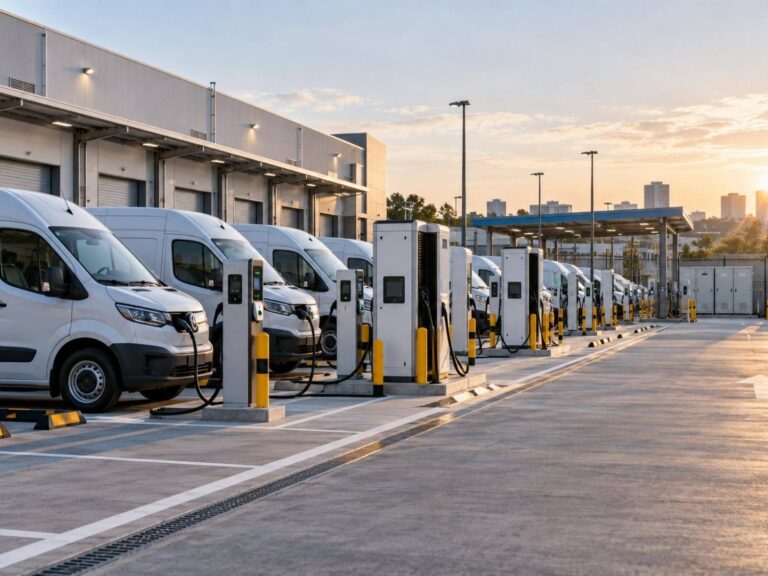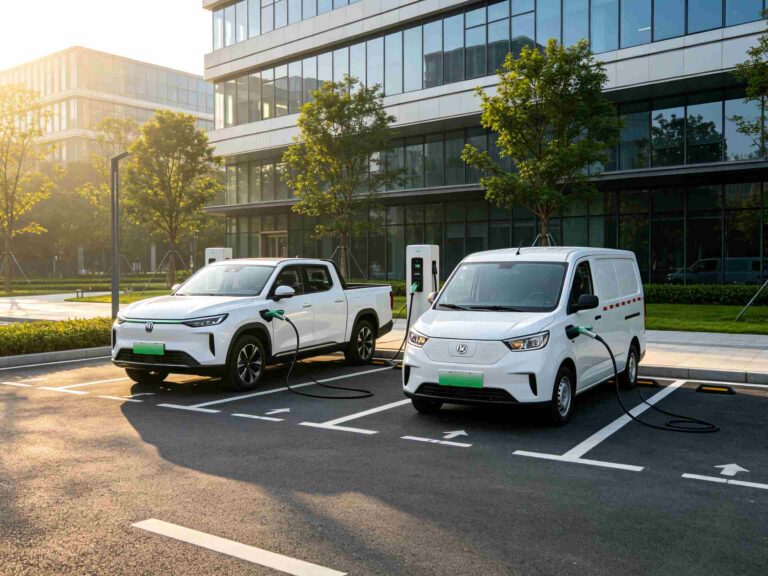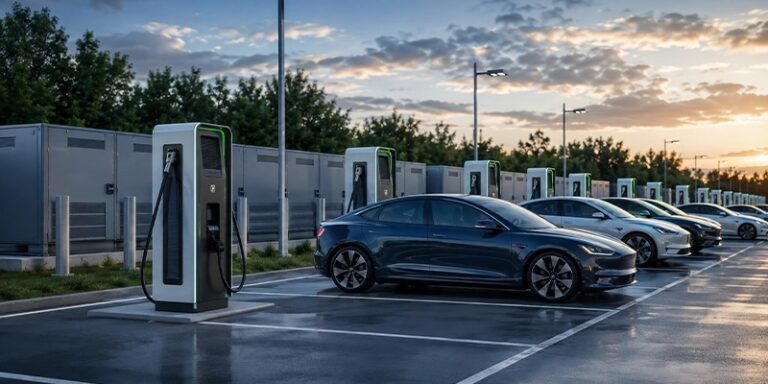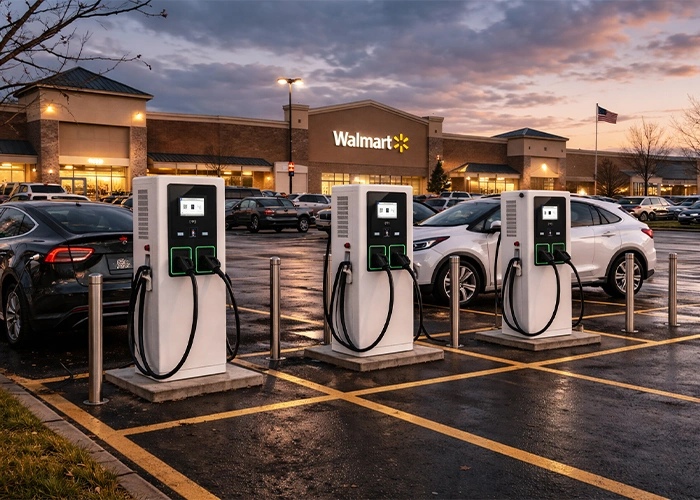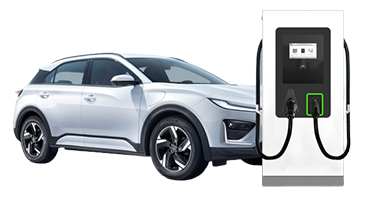
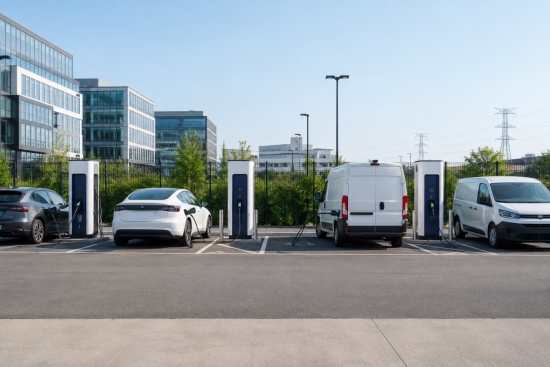
The right DC fast charger power is the lowest rating that can deliver the energy vehicles need within the available charging window, while meeting the site’s throughput target and electrical limits. Choosing the highest available kilowatt rating does not automatically create a better charging site. If vehicles cannot accept the power, utilization is low, or the grid connection cannot support simultaneous demand, the extra capacity may add cost without improving the driver experience.
For most commercial projects, the decision starts with four inputs: energy required per session, vehicle dwell time, the number of vehicles that may charge at once, and available site power. Vehicle charging limits, power-sharing logic, tariffs, operating objectives, and future expansion then refine the final equipment specification.
Start With Energy and Time, Not the Charger Label
A simple planning calculation gives the first power estimate:
Required charger power (kW) = energy required per session (kWh) ÷ available charging time (hours)
For example, a vehicle that needs 60 kWh during a two-hour stop has a simple average requirement of 30 kW. A 20 kW / 30 kW / 40kW DC charger may therefore be a reasonable starting point. If the same energy must be delivered in 30 minutes, the simple requirement becomes 120 kW before charging losses and operating buffers are considered.
In a real project, the calculation is a baseline rather than a guaranteed charging rate. Actual power changes with battery state of charge, temperature, vehicle limits, charger configuration, and site demand.
DC Fast Charger Power Ranges at a Glance
| Power range | Best fit | Main design check |
| 20–40 kW | Longer-dwell commercial parking, offices, hotels, light fleets | Energy can be delivered within the parking window |
| 40–60 kW | Compact public sites, campuses and mixed-use fleet locations | Dual-connector allocation and expected turnover |
| 60–120kW | Intermediate-demand commercial and fleet applications | Vehicle acceptance, charging window, and available site power |
| 120–180 kW | Busy public charging, route-critical fleets and highway locations | Vehicle acceptance, concurrency and utility capacity |
| 240–480 kW | High-throughput hubs and suitable heavy-duty fleets | Documented demand and strong upstream infrastructure |
These ranges are practical starting points, not universal rules. A hotel with long overnight parking may meet its service goal at lower power, while a fleet with fixed departure times may need more connectors, higher output, or both. Confirm the actual model configuration and destination-market requirements before ordering.
Quick Power Guide by Application
| Commercial Application | Starting Power Reference | Why |
| Hotel / Office Parking | 20–40kW | Longer dwell time |
| Light Fleet Depot | 20–60kW | Predictable parking and moderate daily energy demand |
| Campus / Mixed-Use Site | 40–60kW | Moderate turnover and multiple users |
| Urban Public Fast Charging | 60–180kW | Shorter dwell time and higher turnover |
| Highway Charging | 120–480kW | Faster turnaround and high throughput |
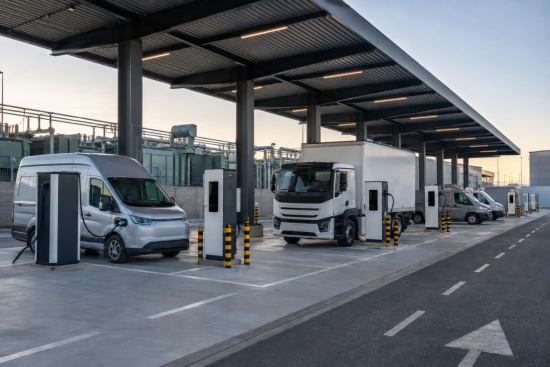
| Heavy-Duty Fleet | 120–480kW | High daily energy demand and route requirements |
These are planning references rather than fixed recommendations. Final charger power should be determined by vehicle charging capability, dwell time, energy demand, simultaneous charging requirements, and site electrical capacity.
6 Factors That Determine the Right Charger Power
1. Vehicle dwell time and required turnaround
A hotel, office park, commercial building, or depot may have hours to replenish a vehicle. A highway stop or high-turnover public station may have only minutes. Longer dwell time reduces the required average power per vehicle. Short stops push the design toward higher output, but only when the target vehicles can use it.
2. Vehicle DC charging capability
The charger and vehicle negotiate every charging session. A vehicle will not automatically draw the charger’s full rated output, and accepted power usually tapers as the battery fills. Review the target fleet or expected local vehicle mix, including connector standard, voltage range, peak DC input, and charging curve, before paying for capacity that users may not access.
3. Energy required per session
Do not size every session as a zero-to-full recharge. Commercial vehicles often arrive with energy remaining and need only enough for the next route, shift, or destination. Estimate typical and peak energy needs from daily distance, vehicle efficiency, route reserve, arrival state of charge, and operating policy.
4. Concurrent charging and power sharing
One 180 kW connector and three 60 kW connectors provide the same total nameplate power, but they create different capacity, queueing, and resilience. For any dual-gun charger, verify total cabinet power, maximum output per connector, the allocation rule when both connectors are active, and whether minimum power can be reserved for each session.
5. Site electrical capacity and tariff
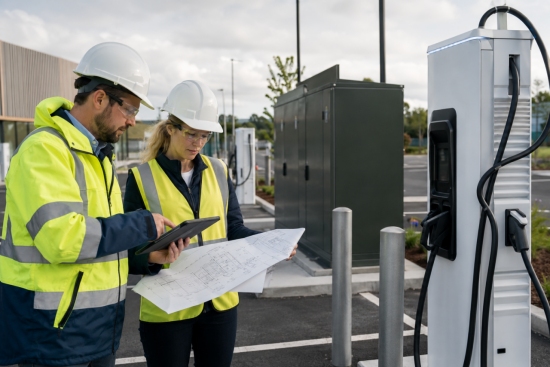
Transformer capacity, switchgear, cabling, protection, utility interconnection, and other building loads can cap practical charger output. Depending on the local tariff, short demand peaks may also affect operating cost. Engage the utility and electrical designer before fixing the hardware rating, especially for multi-charger sites or projects above 120 kW.
6. Utilization and the site’s commercial objective
A fleet depot values on-time departures. A charging point operator values successful sessions, availability, and throughput. A hotel or retail site may value customer dwell time as well as charging revenue. The same vehicle mix can therefore justify different power levels at different locations. Size the system against the operating objective rather than a generic benchmark.
How Each Power Range Fits a Commercial Site
20–40 kW: Longer Dwell Time and Moderate Energy Demand
This range suits sites that need DC charging without highway-style turnaround. U-charging’s 20 kW/30 kW/40kW DC EV charger is offered in wall-mounted or pedestal form with a single connector, 200–1000 V output, APP/RFID access, OCPP 1.6J connectivity, and remote upgrade and diagnostics. Listed applications include commercial parking, office parks, light fleets, and urban public sites.
Choose this tier when vehicles remain parked long enough for moderate charging, upstream power is constrained, or the operator wants to introduce DC service without immediately building a high-power connection. It is less suitable when queues or short turnaround windows make higher throughput essential.
40–60 kW: A Practical Middle Tier for Compact Sites
U-charging’s 40kW / 60 kW dual-gun DC charger supports APP/RFID access, optional POS, OCPP 1.6J, and remote diagnostic capability. The model is positioned for fleet depots, commercial parking, public fast charging, and campus sites.
This tier can serve more than one parking position or improve turnaround without moving directly to a high-power installation. The decisive procurement question is simultaneous-charging behavior: the quotation and technical schedule should distinguish total cabinet power from maximum per-connector output.
120–180 kW: Faster Turnover for Busy Public and Fleet Operations
The 120 kW–180 kW DC fast charger is a floor-standing, dual-gun model intended for highway service areas, commercial fast-charging stations, fleet depots, and urban fast-charging locations. Published features include a 10.1-inch touchscreen, APP/RFID access, optional POS, OCPP 1.6J, multiple connectivity options, and remote upgrade and diagnostics.
Consider this range when short dwell time, frequent sessions, or route-critical operations justify more power. Validate the target vehicles’ charging envelopes and the site’s ability to support simultaneous output. A 180 kW cabinet does not guarantee that every vehicle will receive 180 kW throughout its session.
240–480 kW: High-Power Infrastructure for Documented Demand
U-charging’s 240 kW–480 kW DC fast charger range is designed for high-throughput applications where compatible vehicles, charging demand, and site infrastructure can support higher power levels. Potential applications include highway service areas, heavy-duty fleets, large fast-charging hubs, and urban high-power charging sites. It supports a 200–1000 V output range, multiple connectivity options, OCPP 1.6J, and remote management functions. A 240kW or 480kW rating should not be interpreted as the power every vehicle will receive. Actual charging output depends on vehicle acceptance, battery state of charge, charger configuration, power-sharing between connectors, and available site capacity.
This tier should follow a detailed electrical and operational study. High nameplate power adds little value if vehicles cannot accept it, utilization is too low, both connectors must divide the available output, or the utility connection prevents operation at design capacity. It makes sense where high-throughput demand and the supporting infrastructure are both part of the business case.
One High-Power Charger vs. Multiple Lower-Power Chargers
| Consideration | One High-Power Charger | Multiple Lower-Power Chargers |
| Charging speed | Faster for compatible vehicles | Moderate per vehicle |
| Number of vehicles served | Limited by connector count | More vehicles can charge simultaneously |
| Redundancy | Lower if the unit is unavailable | Higher if one unit is offline |
| Vehicle compatibility | More dependent on vehicle acceptance | Suitable for a broader range of charging needs |
| Site power requirement | Can be concentrated | Can be distributed across multiple units |
| Queue management | May create a bottleneck | More flexible for fleet operations |
| Maintenance impact | One failure can remove significant capacity | Partial service can remain available |
| Best fit | High-turnover, high-power demand | Fleets and sites with multiple vehicles |
| Expansion | Add another high-power unit | Add chargers incrementally |
For example, a depot with predictable overnight parking may obtain more operational value from four 40 kW positions than one 160 kW position. A highway location with short stops may reach its target with one or more 180 kW dispensers, provided the vehicles, power-sharing design, and grid connection support the intended throughput.
8 Steps to Choose the Right DC Fast Charger Power
Step 1. Define the business objective: public charging revenue, fleet readiness, customer amenity, or mixed use.
Step 2. Profile the target vehicles: connector standard, battery capacity, DC voltage range, peak input, and charging curve.
Step 3. Estimate typical and peak energy required per session instead of assuming a full battery recharge.
Step 4. Measure the real charging window and define the required departure time or customer turnover target.
Step 5. Model simultaneous sessions and document how dual-connector equipment shares power.
Step 6. Confirm site capacity, utility requirements, tariff exposure, other building loads, and expansion allowance.
Step 7. Compare one high-power charger with multiple lower-power units on throughput, resilience, and total installed cost.
Step 8. Verify the final model’s connector, certification, communication, payment, and installation requirements for the project country.
Common Power-Selection Mistakes
- Buying the highest rating without checking the target vehicles’ DC acceptance limits.
- Using battery capacity alone while ignoring arrival state of charge and actual route energy.
- Treating total cabinet power as guaranteed output for each connector.
- Ignoring other building loads or assuming a utility upgrade will be quick and inexpensive.
- Designing only for today’s average demand with no conduit, switchgear, or layout allowance for expansion.
- Comparing charger prices without including electrical works, software, demand charges, uptime, and maintenance responsibilities.
Match Power to the Site, Then Select the Charger
U-charging offers configurations for commercial parking, fleets, public charging, highway sites, and high-power hubs. Depending on the selected model, available features include OCPP connectivity, remote management, and form factors suited to different charging environments. The final connector configuration, certification scope, per-connector power allocation, and installation requirements should always be confirmed for the destination market and project.
If you are planning a commercial charging site, send us your project requirements, including the project country, application, target vehicle models, daily charging demand, required turnaround time, available site capacity, number of charging positions, connector standard, and platform requirements. We can discuss a suitable charger configuration, connectivity approach, OEM/ODM options, and support scope. [Talk to Our Engineer].
Frequently Asked Questions
Q: Is a higher-power DC charger always faster?
A: No. Actual charging power is limited by the vehicle, battery temperature and state of charge, charger configuration, concurrent sessions, and site power availability. A higher-rated unit provides capacity, but the vehicle determines how much of that capacity it can use at each point in the session.
Q: How should I choose between 60 kW and 120 kW?
A: Compare the energy required with the available dwell time. A 60 kW unit may be sufficient for longer stops or moderate demand. A 120 kW unit becomes more relevant when compatible vehicles can use the extra power and faster turnover has operational value. Grid capacity and simultaneous charging must also be included.
Q: Can two vehicles use a dual-gun charger at the same time?
A: Many dual-gun systems support simultaneous sessions, but allocation logic varies. Confirm total cabinet power, connector maximums, minimum guaranteed output, and the rule used when a second vehicle connects.
Q: What information is needed before requesting a charger recommendation?
A: Provide the destination country, intended application, vehicle models, connector standard, battery and charging data, daily vehicle volume, energy required per session, dwell time, site electrical capacity, number of ports, payment or access method, OCPP platform requirements, and deployment schedule.