Choosing an EV charger OEM manufacturer involves more than selecting a logo or product color. Distributors, CPOs and commercial operators must confirm the charging power, connector standard, communication protocol, certification requirements, branding scope, production capacity and after-sales support before placing an order.
U-charging provides AC and DC EV charger OEM/ODM solutions for market-specific charging projects. Partners can select suitable hardware, define the required customization scope and validate the product before mass production.
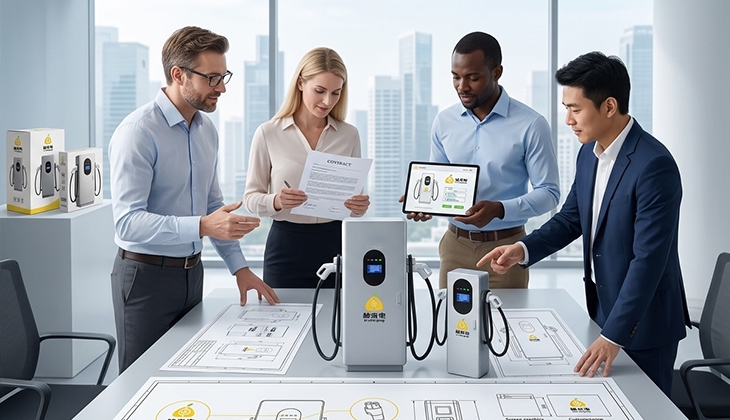
How to Choose an EV Charger OEM Manufacturer
A suitable OEM manufacturer should provide more than a branded product. Buyers should review the manufacturer’s product platform, engineering capability, sample-testing process, production capacity, documentation, regional compliance and after-sales support. These factors help determine whether the supplier can support both the initial order and future deployment.
Product and Engineering Capability
Confirm whether the manufacturer can provide the required AC or DC power range, connector standard, installation format, communication functions and branding options.
Sample and Quality-Control Capability
Ask whether the supplier can provide samples, test reports, inspection records and a clear process for maintaining consistency between the approved sample and mass-produced units.
Delivery and After-Sales Capability
Confirm the MOQ, sample lead time, production lead time, export documents, spare parts, warranty scope and technical-support process before placing an order.
U-charging OEM/ODM Cooperation Process
1. Requirement Confirmation
The project starts by confirming the target market, application scenario, product type, charging power, connector standard, installation method, backend requirements, branding scope and estimated order quantity.
2. Equipment Selection
U-charging recommends suitable AC or DC charger models based on the required power, vehicle types, dwell time, site electrical capacity, connector standard and installation conditions.
3. Brand Customization
The customization scope may include the logo, housing color, user interface, display language, warning labels, nameplate, packaging and product documentation. The available options depend on the selected model and project requirements.
4. Quotation and Sample
After the technical scope is confirmed, U-charging prepares a quotation and, where required, a sample plan. The quotation should identify standard features, optional features, tooling costs, sample costs, minimum order quantity, lead time and delivery terms.
5. Testing and Confirmation
The sample is reviewed for appearance, charging performance, connector compatibility, communication, user interface, backend integration, safety functions and documentation. Any changes should be recorded and confirmed before mass production.
6. Mass Production
After sample approval and order confirmation, production proceeds according to the approved technical specification, artwork, bill of materials and quality-control requirements.
7. Export Delivery
Before shipment, the parties confirm inspection results, packaging, shipping marks, export documents, certificates, spare parts and delivery terms.
8. After-Sales Support
After delivery, U-charging can provide technical documentation, remote support, troubleshooting guidance, spare-parts coordination and assistance with installation, commissioning and maintenance, subject to the agreed service scope.
This staged process helps align the technical specification, approved sample and mass-production output.
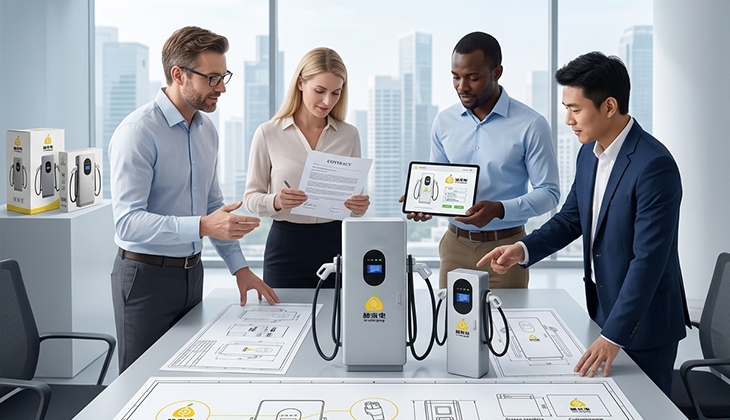
What OEM EV Charging Solutions Can Include
AC and DC Hardware Configurations
The U-charging 7kW / 11kW / 22kW Smart AC EV Charger is available in 7kW, 11kW, and 22kW configurations. Other U-charging AC models are available in higher-output and dual-gun configurations depending on the project. These work well for hotels, workplaces, and retail parking. U-charging offers DC charging solutions across multiple power ranges, from compact commercial chargers to high-power 240–480kW DC fast charging systems. Exact output configurations depend on the selected model and project requirements. Choosing the right one depends on how long cars stay parked and the total power available at the site.
Communication and OCPP Integration
U-charging hardware may connect through 4G, Wi-Fi, Ethernet or Bluetooth. Selected models support OCPP 1.6J. Backend compatibility should be validated against the charger model, firmware version and target CSMS. Remote monitoring, diagnostics, OTA updates and smart charging functions depend on the selected model and system configuration.
| OEM/ODM Approach | Typical Scope | Best Fit | Typical Customization |
|---|---|---|---|
| OEM | Branding, appearance, UI, packaging | Distributors, private-label brands | Logo, colors, UI, packaging |
| ODM | Hardware, firmware, mechanical and system design | CPOs, charging solution providers | Product architecture and functions |
| Standard Product | Existing model and specifications | Trial orders and fast deployment | Limited configuration |
U-charging AC and DC Options for OEM Projects
U-charging offers AC and DC charger configurations for destination parking, commercial properties, fleet depots and public charging hubs. The appropriate model depends on vehicle dwell time, site power capacity, connector requirements, installation space, cable management and backend integration. Final model selection should be confirmed during the equipment-selection and sample-validation stages.
OEM Selection Checklist
Confirm the Technical Specification
Start by defining the power output and the required connector standard and charging configuration. Look at how the unit connects to the internet and what safety protections are inside. Always ask which hardware, firmware, mechanical, UI, and branding elements are configurable and which remain standardized.
Review Documentation and Support
Before ordering, confirm that the supplier can provide user manuals, wiring diagrams, installation instructions, troubleshooting procedures and spare-parts information.
Check Backend Compatibility
Before procurement, test the charger’s communication, supported OCPP functions, network connection and remote-control features with the target CSMS.

Where U-charging OEM Solutions Fit
Distributors and Installers
Distributors, installers, and system integrators can combine U-charging hardware with local installation, commissioning, maintenance, and customer support services. A standardized product portfolio can simplify installer training, spare-parts planning, commissioning procedures, and long-term maintenance.
CPO and Public Networks
CPOs and charging network operators can use a standardized charger configuration across sites to simplify commissioning, monitoring, maintenance and spare-parts planning.
Fleets, Hotels, and Commercial Properties
Property owners can combine AC and DC units for employees, visitors or fleet vehicles. The selected configuration should match the site’s electrical capacity, parking layout and operating requirements.
Conclusion
U-charging combines AC and DC charging platforms with OEM/ODM customization, technical validation, documentation and project support for distributors, CPOs, fleets and commercial operators. Tell us about your market, charging requirements and customization scope. Our team can help evaluate suitable AC or DC charger configurations, technical requirements, sample validation and production planning. Get an OEM/ODM Evaluation.
FAQ
Q: What information should I provide for an EV charger OEM project?
A: Please provide the target market, application scenario, product type, charging power, connector standard, installation method, backend requirements, OEM scope and estimated order quantity.
Q: Can I request a sample before placing a bulk order?
A: Sample availability depends on the selected model, customization scope and project requirements. Sample testing and approval should be completed before mass production.
Q: What should be included in an OEM quotation?
A: The quotation should clarify the charger model, power, connector, standard features, optional features, customization scope, sample or tooling costs, MOQ, lead time, packaging, delivery terms and after-sales scope.